
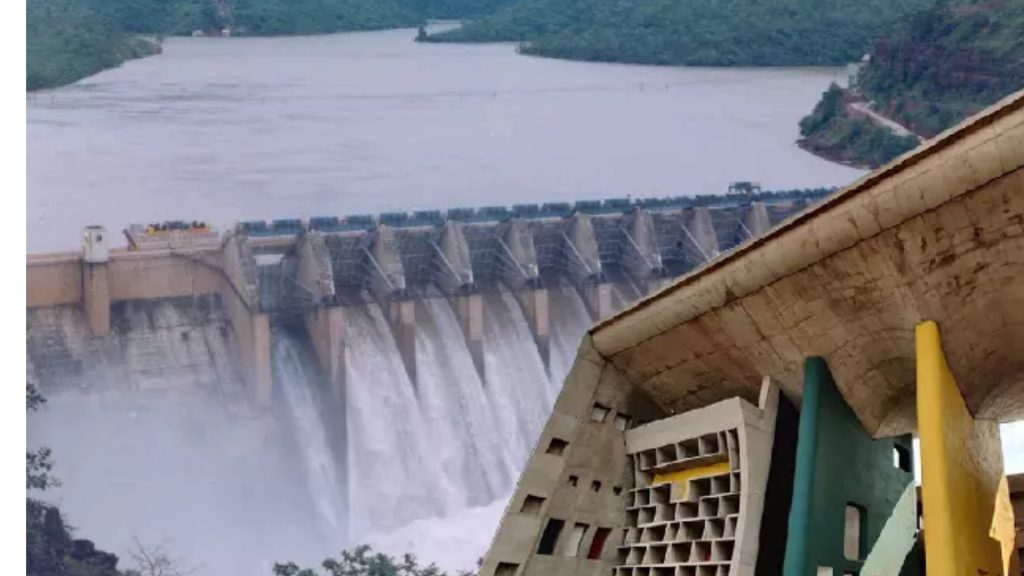

Sixty-two years after its dedication to the nation, the Bhakra Dam, a monumental symbol of India’s green revolution, is preparing for its first-ever major desilting operation.
The landmark decision, spurred by recent devastating floods and a critical loss of storage capacity, marks the beginning of a massive desilting project. It is aimed at reinforcing the dam’s structural integrity and restoring its ability to manage water, power, and flood control across four northern states.
The one-year pilot project:
Responding to the crisis and these continuous calls for action, the Union Ministry of Jal Shakti has constituted a high-level 10-member committee to oversee the desilting process.
The Bhakra Beas Management Board (BBMB) is initiating the effort as a critical one-year pilot project, focusing on the highly accessible silt deposits located in the Satluj River near Bilaspur, upstream of the dam wall.
The circularity push:
The Bhakra Dam desilting project functions as a circular economy model by transforming the silt—a waste product that caused a critical 26% loss in storage capacity—into a commercial resource.
The circularity plan includes:
Utilization by NHAI: BBMB has proposed that the extracted silt and sand be utilized by the National Highways Authority of India (NHAI).
Specific Use: The material will be used for road embankments and earth-filling in ongoing key infrastructure projects.
Sustainability Aspect: By utilizing the mineral-rich silt in construction, the project achieves two major sustainable goals:
It avoids the creation of a massive new dumping ground, which would adversely impact the chosen site. The strategic approach, as detailed in the BBMB’s proposal and financial model, champions resource circularity: the recovered material is primarily intended for beneficial reuse, effectively diverting it from becoming waste to landfill.
It reduces the reliance on virgin aggregate mining for road construction, lowering both environmental impact and construction costs for the NHAI.
Innovative financial model:
The key features of the desilting project’s self-funding model are
• Innovative Financial Structure: The entire operation is executed under the Dam Rehabilitation and Improvement Project (DRIP) Phase II & III as a first-of-its-kind, self-sustaining, and revenue-generating model.
• Cost Neutrality: While initial operational costs are substantial, the project’s design anticipates no net cost. The Union Ministry of Jal Shakti expects no separate fund requirement, as the revenue fully offsets the expenditure.
• Revenue Generation: The model is centered on the commercial sale of the extracted mineral-rich silt (sand and minerals), which generates the necessary funds to cover dredging and extraction costs.
• Beneficial Reuse: The primary buyer is infrastructure agencies, such as the National Highways Authority of India (NHAI), utilizing the material for construction, which also helps reduce overall infrastructure costs and the burden on the public exchequer.
• Revenue Sharing: Proceeds from the sale are distributed among the partner states. Himachal Pradesh receives its standard royalty from the mining, and the BBMB retains additional revenue to benefit all partner states (Punjab, Haryana, and Rajasthan).
The scale of the crisis: siltation and capacity loss
The sheer scale of the siltation crisis demanded urgent action. Since its commissioning in 1963, the Gobind Sagar reservoir, which feeds the dam, has lost an estimated 25 to 26 percent of its live storage capacity. While the dam was originally designed to handle approximately 33.61 million cubic meters (MCM) of silt annually, the BBMB officials now report that the actual sediment inflow has surged to between 38 and 39 MCM per year. The massive sedimentation, fueled by deforestation, intense construction, and road-widening projects in the upper Satluj catchment area, has effectively choked the reservoir, reducing its effective water-holding capacity and making flood control significantly more challenging.
Political urgency and the ticking time bomb:
The threat posed by this neglect was sharply highlighted during the 2025 monsoon season. Punjab’s Water Resources Minister, Barinder Kumar Goyal, had long championed the need for a comprehensive audit and subsequent desilting, pointing to the structural and operational risks. Echoing this urgency, another prominent state minister, Harjot Singh Bains, had previously termed the dam an “alarming ticking time bomb,” demanding that the Centre address the decades of accrued sedimentation that jeopardizes the dam’s original 100-year design life.
Securing the future: benefits for northern states
For millions in Punjab, Haryana, and Rajasthan who rely on the Bhakra Dam for irrigation and power generation, this desilting project offers a renewed lease on life.
Media reports quoted a technical expert, who stated, “If successful, this pilot project will not only restore crucial storage capacity for power generation—which stands at 1325 MW installed capacity—but, more importantly, it will strengthen flood management capabilities, mitigating the kind of devastation we saw this past year. This decision secures the life and livelihood dependent on this national lifeline for decades to come.”
Other Indian dams affected by sedimentation:
Many of India’s large reservoirs are experiencing significant capacity loss due to sedimentation, a challenge recognized by several national and international studies. An IISER Bhopal report highlighted that dams across India have lost nearly 50% of their storage capacity due to silt buildup.
• Tungabhadra Dam (Karnataka): This dam is frequently cited as one of the most affected reservoirs. An analysis by the Karnataka Water Resources Department revealed that it has accumulated a significant amount of silt (e.g., 31.61 TMC in 75 years). Siltation is so severe that proposed removal projects have massive cost estimates.
• Basavasagar (Narayanpur) Dam (Karnataka): This dam has one of the highest percentage siltation losses in Karnataka, reported at around 28%.
• Ranjit Sagar Dam / Thein Dam (Punjab/J&K): This dam, along with Bhakra and Pong, is part of the system that is under high stress due to sediment inflow, impacting its original storage capacity.
Studies indicate that reservoirs in the Himalayan region, the Indo-Gangetic plains, and the Narmada-Tapi basin are classified as high or very high vulnerability zones, meaning numerous dams in these areas face severe threats to their water and energy security.
It must be noted that the UN study on global dam storage loss predicts that, on average, India’s approximately 3,700 large dams will have lost 26% of their initial total storage capacity by 2050.