

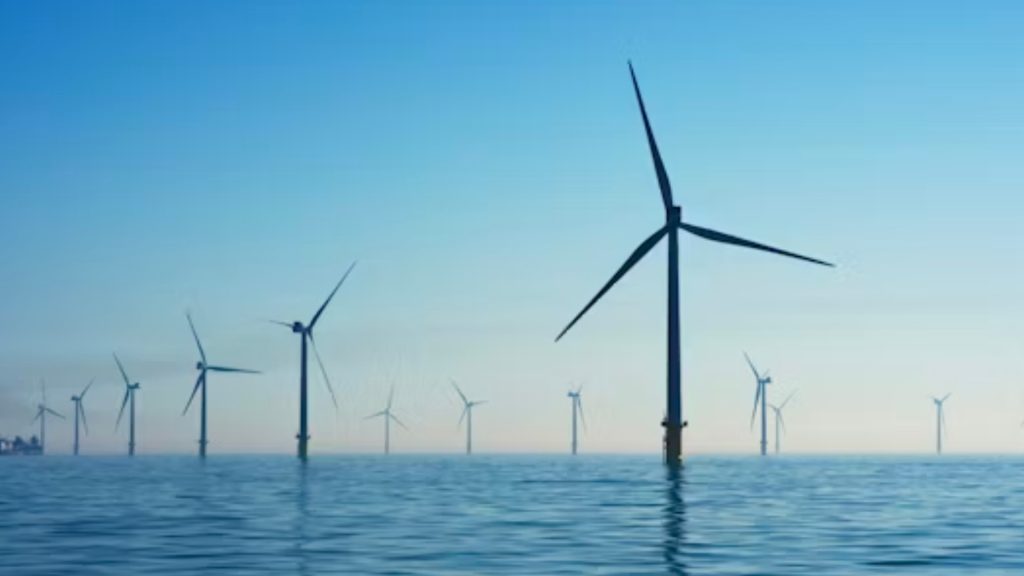

In a move to revolutionize renewable energy, Japan has recently reached a critical milestone by lifting its first large-scale wind turbine wall prototype above the ocean.
Developed by the Research and Education Center for Offshore Wind (RECOW) at Kyushu University, the wind turbine deviates from the traditional lone tower model. Instead, it utilizes a honeycomb matrix of interconnected. Wind Lens turbines. By clustering these units into a single vertical wall, researchers have successfully demonstrated a power output that is three times higher than that of a standard offshore turbine of comparable size.
The technology:
The core technology relies on a wind lens—a brimmed diffuser shroud that encircles each turbine blade. This shroud creates a low-pressure zone behind the rotor, which effectively sucks more wind through the blades and accelerates the airflow. When multiple lenses are linked in a wall configuration, they create a synergistic effect where the wind is channeled and accelerated even further between the units. This eliminates the wake interference that usually forces developers to space turbines hundreds of meters apart, allowing for a much smaller physical footprint.
Economic impact:
The Wind Turbine Wall is poised to significantly lower the levelized cost of energy (LCOE) for floating offshore wind. Current projections suggest that as these modular walls scale, they could help Japan reach its target of reducing offshore wind costs to approximately $70/MWh by 2035. Because the wall utilizes smaller, standardized blades, it reduces the need for the massive, specialized cranes and vessels required for traditional 15 MW mega-turbines. This modularity translates to lower capital expenditure (CAPEX) and more resilient operations in Japan’s typhoon-prone waters.
Navigating the EEZ:
This technological leap coincides with Japan’s new EEZ Law, which opens the country’s economic zone for offshore development. With the world’s sixth-largest sea area, Japan’s floating wind potential is estimated at 1,600 GW. The Wind Wall is seen as the primary vehicle to harness this potential, providing a domestic energy source that reduces reliance on expensive, volatile LNG and coal imports.
“By moving beyond the limitations of single-rotor physics, we have unlocked a way to harness the ocean’s wind with unprecedented density. The wall is not just a structure; it is a specialized instrument that triples our power potential while coexisting peacefully with our marine environment and local fishing industries,” said Professor Emeritus Yuji Ohya, Lead Researcher at Kyushu University, and Head, RIAMwind.