
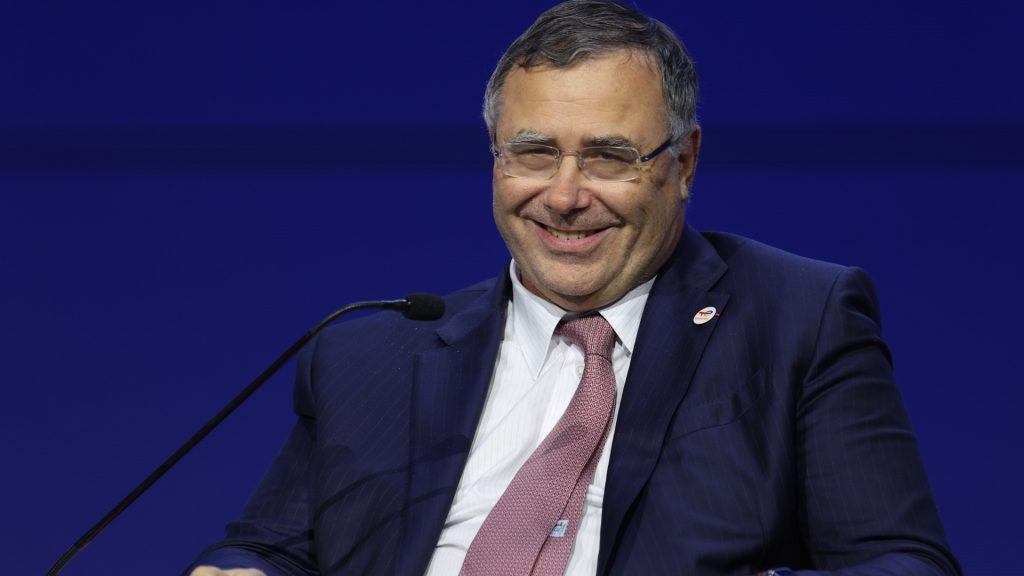

TotalEnergies has announced a significant reduction in its planned investments for clean fuel production, specifically targeting sustainable aviation fuel (SAF).
The announcement, made by CEO Patrick Pouyanné at the World Economic Forum, marks a sharp reversal from the company’s previous aggressive growth stance. The pivot is a direct response to signals that the European Union may water down its ReFuelEU Aviation mandates—the very regulations designed to create a market for high-cost green fuels.
Responding to regulatory uncertainty:
Pouyanné’s decision to bet against these targets stems from the EU’s recent softening of the 2035 combustion-engine car ban. He argues that because SAF currently costs three to four times more than fossil kerosene, airlines will successfully lobby to lower the 6% mandate to avoid massive ticket price hikes.
“I will make a bet today. What happened to the car regulation will happen to the SAF regulation in Europe,” said Patrick Pouyanné, CEO, TotalEnergies. “Without regulation, there is no market. I will invest less in this because I’m afraid that if they move the targets, I will have invested in biorefineries for nothing.”
The abatement shift: renewables vs. biofuels
TotalEnergies is not exiting the transition but is shifting its capital to where it sees better value. Pouyanné noted that the cost of carbon abatement (the price paid to avoid one ton of CO₂ for solar and wind power) is approximately $200/t, whereas for SAF, it can reach $400/t.
| Energy Segment | Cost of Carbon Abatement | Investment Outlook |
| Integrated Power (Solar/Wind) | ~$200 per ton of $CO_2$ | Growing: Primary focus for low-carbon Capex. |
| Sustainable Aviation Fuel | ~$350 – $400 per ton of $CO_2$ | Reduced: Pausing expansion beyond immediate mandates. |
Impact on net-zero ambitions:
This pivot creates a potential supply-demand trap. While TotalEnergies has already secured long-term offtake deals with Air France-KLM and Airbus, the wider industry depends on these energy majors to build the infrastructure today for the fuels of tomorrow. By stalling investment in additional capacity, the company warns that the EU may face a green fuel shortage by 2030 if the mandates are eventually enforced but the production facilities aren’t built in time.
The backdrop:
Until now, TotalEnergies has been one of Europe’s most ambitious SAF proponents. To meet its goal of producing 1.5 million tons of SAF annually by 2030, the company has committed billions to industrial transformations:
- Grandpuits (France): A €500 million conversion of a former oil refinery into a zero-crude biorefinery, aiming for 285,000 tons of SAF by 2027.
- La Mède (France): A €340 million investment to produce SAF and renewable diesel from waste oils and animal fats.
- Global Footprint: Strategic co-processing at traditional refineries in Normandy, Antwerp, and Leuna to maximize early-stage blending.
These investments were predicated on a regulatory staircase that mandates SAF usage jump from 2% in 2025 to 6% in 2030, eventually hitting 70% by 2050.