
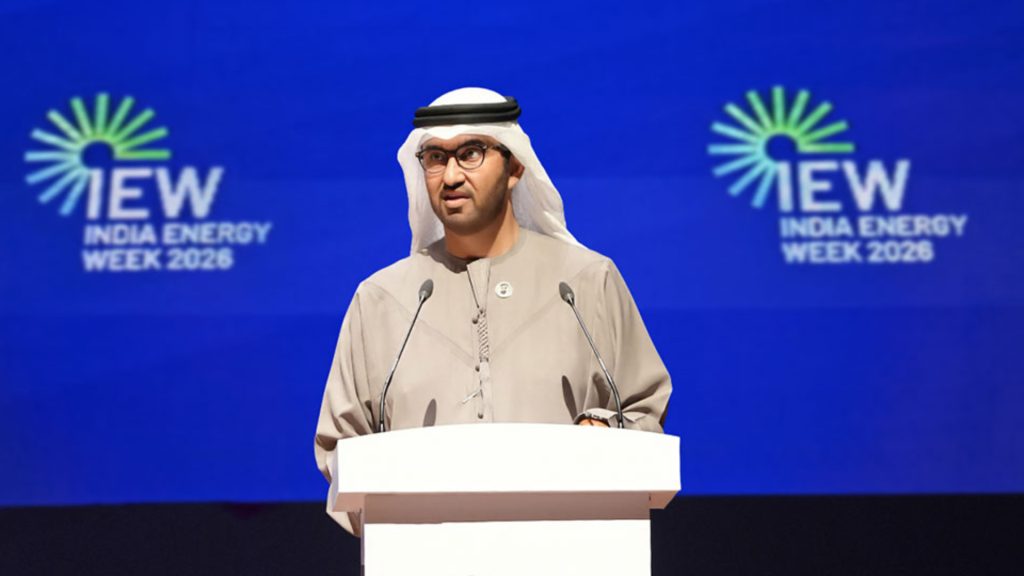

Electricity demand will be driven increasingly by cooling rather than solely by AI and data centers, said, Dr. Sultan Al Jaber, UAE Minister of Industry and Advanced Technology, and Group CEO, ADNOC. Speaking at India Energy Week 2026, he urged investments in all energy forms as air conditioners eclipse AI in driving electricity demand.
The global air-conditioner numbers are projected to more than triple to 5.6 billion by 2050—equivalent to ten units sold every second for the next 30 years. In India, AC electricity demand is set to grow ninefold by 2050, exceeding today’s total power consumption across Africa, while adding 130-150 million units over the next decade amid heatwaves and urbanization. This could quadruple urban peak demand by 2050 from 2022 levels, each 1°C temperature rise above 24°C boosting demand 2% and straining grids.
“Demand at this scale and pace requires investment in all forms of energy,” Dr. Al Jaber said. “The biggest risk is not oversupply, it is underinvestment.”
India’s AC market, valued at $3.88 billion in 2024, is forecast to hit $13.43 billion by 2033 at a 14.78% CAGR, outpacing data center power growth (projected at 6% of national electricity by 2030).
India as a decisive driver of global energy demand:
India, the world’s third-largest energy consumer, leads these megatrends: emerging market rise, AI expansion, and energy transformation. Air travel will grow 150% over the next 15 years. During this time, the global urban population will approach one billion people. Data center capacity is expected to surge tenfold. By 2035, the total number of air conditioning units will multiply 4.5 times according to the IEA.
These converging trends will place immense pressure on global energy infrastructure. Cooling electricity demand is projected to strain power systems significantly. This shift will add over 180 GW to peak demand by 2035.
“Progress and growth at this scale requires a special kind of partnership—strategic, long-term, agile, steadfast, and based on trust,” Dr. Al Jaber said. “This defines the UAE–India relationship.” India tops UAE LNG imports, with ADNOC leading in LPG, crude, chemicals, and feedstocks; bilateral trade aims to double to $200 billion by 2032.
UAE’s commitment to India’s clean energy ambitions:
UAE backs India’s goals via ALTÉRRA’s 11GW in wind, solar, and storage. ADNOC’s XRG expands gas, chemicals, and infrastructure for digital/industrial scale. Dr. Al Jaber invited investors to UAE for stable returns and governance.
ADNOC deploys 200 AI tools and 65 robotics, including the world’s first agentic AI for energy. Amid volatility, such partnerships are the real strategic reserve.
Oil will remain above 100 million barrels per day, with LNG and electricity needs rising 50% by 2040, he said.