

Mobileye has announced today a US-based automaker has selected its EyeQ 6H-powered Surround ADAS system to serve as standard equipment across a vast range of mainstream and premium models.
The agreement marks the second major global partnership for the EyeQ6H platform following a similar deal with Volkswagen Group in March 2025.
Technology:
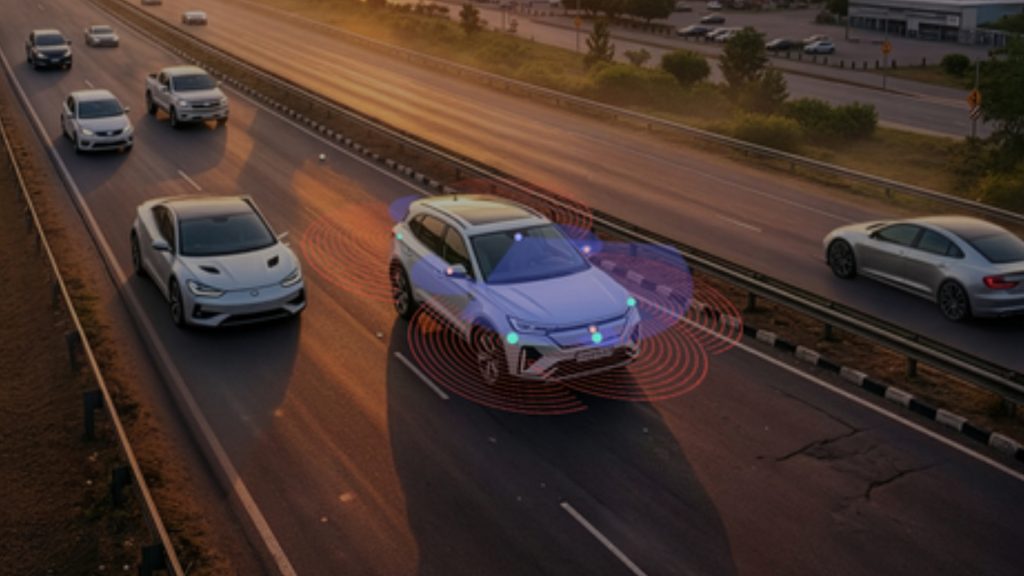
Unlike older systems that require multiple electronic control units (ECUs), the Mobileye Surround ADAS integrates software and multiple driving functions onto a single EyeQ6H chip. This vertical integration lowers costs for automakers and simplifies the transition to software-defined vehicle architectures. The system supports hands-free, eyes-on driving at speeds up to 130 kph (81 mph) in designated areas, featuring automated lane changes and traffic jam assist.
Data-driven safety and mapping:
The technology utilizes a suite of up to 11 sensors, including high-resolution cameras and radars, managed by a single processor. A critical component of the hands-free capability is Mobileye’s REM crowdsourced mapping data, which already covers nearly all highway and arterial roads in the US and Europe. Currently, over 8 million vehicles globally harvest the anonymized data to ensure precise and reliable navigation for ADAS systems.
Scale:
The new contract covers approximately 9 million vehicles, expanding Mobileye’s delivery outlook. The company now estimates more than 19 million EyeQ6H-based systems will be delivered to global customers in the coming years. By making advanced driver assistance standard rather than an optional luxury, the partnership aims to democratize high-end safety technology for millions of drivers worldwide.
According to Prof. Amnon Shashua, President and CEO, Mobileye, “This selection of Mobileye Surround ADAS by one of the world’s great automakers reflects the power of our approach to democratizing safety and technology. Leveraging the EyeQ6H as a powerful central processor for ADAS enables better performance, increased features, and greater flexibility for automakers and their customers, all at a lower cost.”